
What Is an SEO Audit?
An SEO audit is a systematic review of a website’s technical health, on-page optimization, content quality, and backlink profile to identify what’s holding back search rankings and traffic. A good audit doesn’t just flag problems — it prioritizes them by impact, so you fix what actually moves rankings first instead of chasing minor issues.
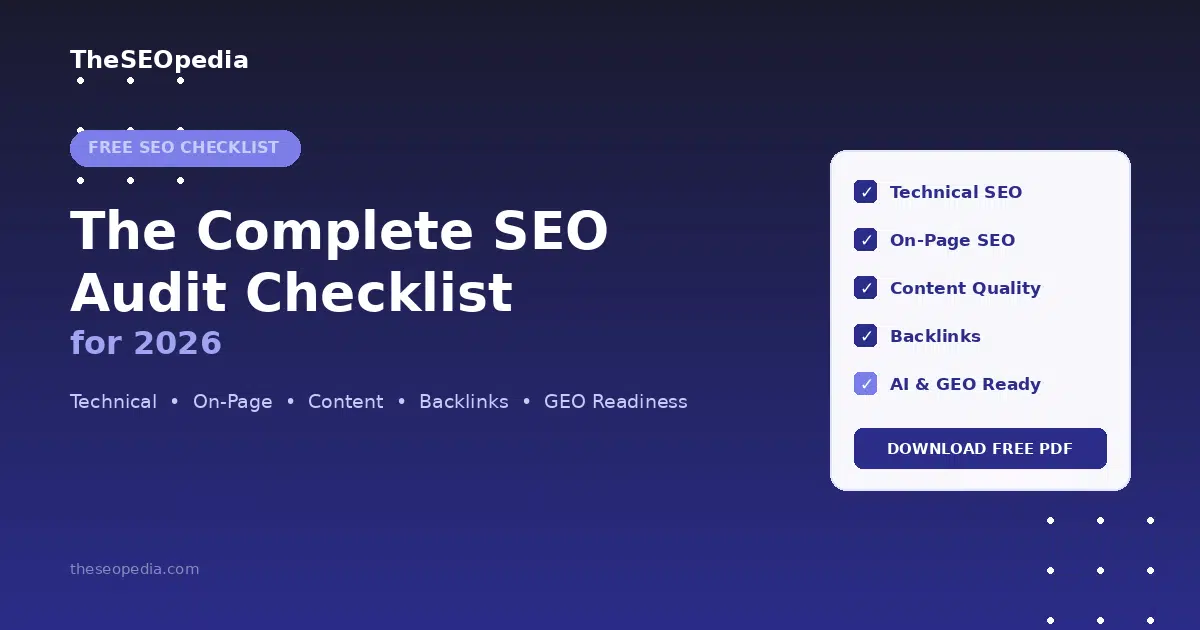
Quick answer: A complete SEO audit checklist for 2026 covers five areas — technical SEO, on-page SEO, content quality, backlinks, and AI/GEO readiness. Below is a full checklist for each, plus a free downloadable PDF version you can print or run through with your team.
📥 Get the free printable checklist: Download the SEO Audit Checklist PDF — the same checklist below, formatted for printing or sharing with your team.
1. Technical SEO Checklist
Technical issues are worth fixing first – strong content on a slow or unindexed site won’t rank no matter how good it is.
- The site loads in under 2.5 seconds (check Core Web Vitals in Search Console)
- The site is mobile-friendly and passes Google’s mobile-friendly test
- XML sitemap exists and is submitted to Search Console
- Robots.txt isn’t accidentally blocking important pages
- HTTPS is enabled site-wide with no mixed-content warnings
- No major crawl errors in Search Console (404s, server errors)
- Canonical tags are set correctly on every page
- URL structure is clean and consistent (no unnecessary dynamic parameters)
2. On-Page SEO Checklist
On-page fixes are usually the fastest to implement and often show results within weeks.
- Every page has a unique, keyword-front-loaded title tag under 60 characters
- Every page has a unique meta description under 155 characters
- One clear H1 per page, with a logical H2/H3 hierarchy beneath it
- Primary keyword appears naturally in the first 100 words
- Images have descriptive alt text
- Internal links point to relevant related pages using descriptive anchor text — for example, linking out to a resource like our guide to long-tail keywords when the topic is directly relevant
- URL slugs are short and keyword-relevant
3. Content Quality Checklist
This is where most audits fall short — technical and on-page fixes matter, but content that doesn’t genuinely serve the reader won’t hold rankings even after everything else is fixed.
- Content matches search intent for the target keyword (informational, commercial, transactional)
- Content is more comprehensive or more current than the top-ranking competitor
- Claims and statistics are sourced and accurate
- Content includes a direct, self-contained answer near the top for snippet and AI Overview eligibility
- Content is reviewed and updated at least once every 6-12 months, with the date visible
- No duplicate or near-duplicate content competing against itself across pages
4. Backlink & Off-Page Checklist
Link building has changed significantly — if you’re still relying on the old profile/directory model, it’s worth revisiting your approach (our breakdown of current guest posting sites and link building methods covers what actually works now).
- Backlink profile reviewed for spammy or toxic links, disavowed if needed
- Top competitor backlinks reviewed for realistic, replicable opportunities
- At least one linkable asset exists (a free tool, template, or original data) to attract natural links
- Unlinked brand mentions checked and reclaimed where possible
- Guest post and digital PR targets are chosen for niche relevance, not just high domain authority
5. AI Search & GEO Readiness Checklist
Traditional rankings and AI-generated answers increasingly reward the same fundamentals — clear structure, genuine expertise, and accuracy — but a few things are specific to how AI engines extract and cite content.
- Key pages include a clear, self-contained definition or summary near the top
- FAQ sections use accurate FAQPage schema markup that matches the visible text exactly
- Content is structured with descriptive H2s phrased as real user questions
- Author bio and credentials are visible on every article, supporting E-E-A-T
- Pages avoid excessive self-promotion, which can reduce third-party citation trust
How Often Should You Run an SEO Audit?
Most sites should run a full audit every 6-12 months, with lighter monthly checks on Core Web Vitals, crawl errors, and keyword rankings in between. If you’ve recently migrated domains, redesigned your site, or seen a sudden traffic drop, run a full audit immediately rather than waiting for the next scheduled check.
Prioritizing What to Fix First
Not every item on this checklist carries equal weight. A practical order of operations:
- Fix crawl and indexing issues first — content that isn’t indexed can’t rank at all.
- Fix Core Web Vitals and mobile usability next — these affect every page on the site at once.
- Then move to on-page and content gaps on your highest-traffic-potential pages.
- Finally, address backlinks and GEO structure — these compound over time rather than producing immediate jumps.
FAQs
What is an SEO audit?
An SEO audit is a systematic review of a website’s technical health, on-page optimization, content quality, and backlink profile to identify issues that are holding back search rankings and traffic.
How often should I run an SEO audit?
Most sites should run a full SEO audit every 6 to 12 months, with lighter monthly checks on Core Web Vitals, crawl errors, and keyword rankings in between.
Can I do an SEO audit myself without hiring an agency?
Yes. Free tools like Google Search Console, Google PageSpeed Insights, and a structured checklist cover most of what a paid audit tool checks. Agencies add the most value in prioritizing fixes and handling complex technical issues, not in finding basic problems.
What is GEO and why does it matter for an SEO audit?
GEO, or Generative Engine Optimization, is the practice of structuring content so AI answer engines like Google AI Overviews, ChatGPT, and Perplexity can extract and cite it accurately. A modern SEO audit should check for GEO readiness alongside traditional ranking factors, since both increasingly rely on the same fundamentals of clear structure and genuine expertise.
What’s the single highest-impact fix in most SEO audits?
For most sites, fixing Core Web Vitals and crawl errors produces the fastest visible improvement, since these issues can prevent otherwise strong content from being indexed or ranked at all.